
If you are over 40 and trying to conceive, you have almost certainly been told that your chances are significantly reduced. That your eggs are older. That time is running out. That IVF — with your own eggs, or possibly donor eggs — is your most realistic option.
I want to give you a fuller picture. Because the story of fertility over 40 is more complex, more hopeful, and more within your influence than most women are led to believe.
Age and Fertility — The Real Picture
Yes, fertility declines with age. This is biological reality and I will not minimise it. The number of eggs in reserve decreases, and the rate of chromosomal abnormalities in eggs increases as women get older.
But here is what the statistics do not capture: individual physiology.
The fertility statistics cited by clinics are population averages. They describe what happens across large groups of women. They say nothing about what is possible for you specifically — based on your constitution, your physiological health, your hormonal environment, and the quality of the eggs you are growing right now.
AMH — the hormone most commonly used to assess egg reserve — does not predict natural conception. The American College of Obstetricians and Gynecologists has stated this clearly. A JAMA study of 750 women confirmed no significant difference in natural conception rates between women with low and normal AMH.
Age is a factor. It is not a verdict.
What Changes After 40 — and What You Can Do About It
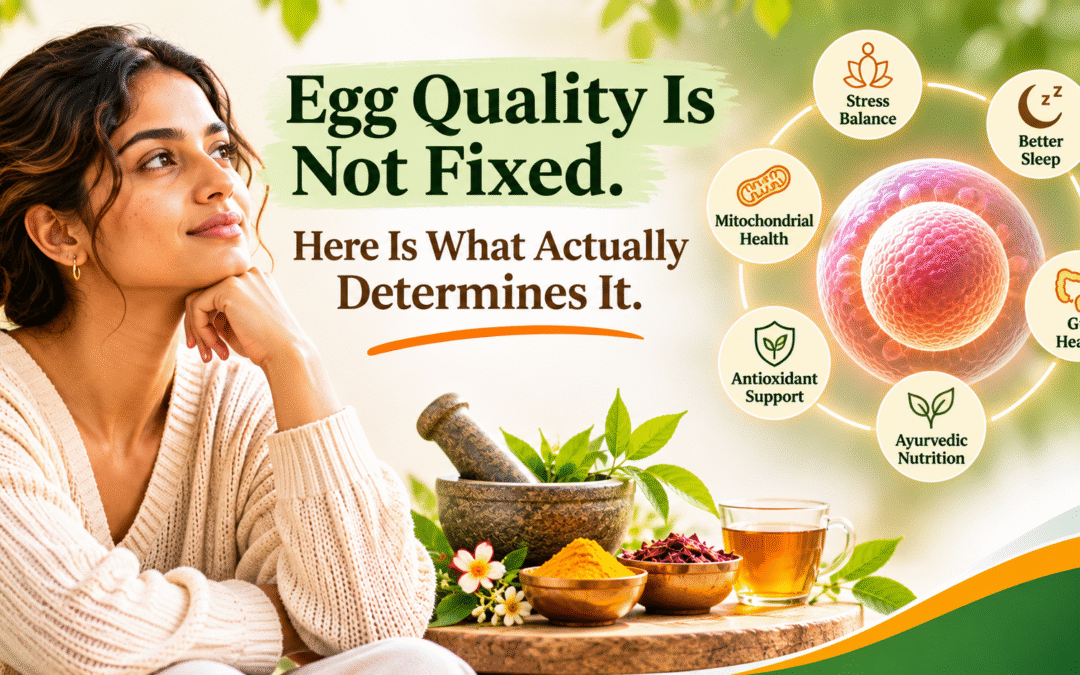
The primary fertility challenge after 40 is mitochondrial function. Mitochondria — the energy producers inside each egg cell — become less efficient with age. This affects the egg’s ability to complete fertilisation, support early embryo development, and implant successfully.
But mitochondrial function is not purely determined by age. It is also determined by oxidative stress, nutritional status, sleep quality, inflammatory load, and the physiological environment your eggs are developing in. All of these are addressable.
CoQ10 research by Bentov and colleagues demonstrated direct improvement in egg quality with mitochondrial support in women over 35. This is not a marginal finding. It is a meaningful intervention that changes the cellular environment your eggs are growing in.
Melatonin — present in follicular fluid — plays a direct role in protecting the egg from oxidative stress during maturation. Sleep quality directly affects melatonin production. Many women over 40 on the fertility journey are sleeping poorly — driven by anxiety, by the medical process, by the weight of the journey itself. This creates a cycle that directly worsens the physiological environment for egg development.
The Ayurvedic Perspective on Fertility Over 40
In Ayurvedic medicine, we do not look at age as a fixed biological ceiling. We look at the condition of the tissue.
Shukra dhatu — the reproductive tissue — is the deepest and most refined tissue in the body. It is the last to be nourished when resources are scarce, and the first to be depleted when the system is under sustained stress. By the time many women reach their late thirties and forties, the reproductive tissue has been depleted not simply by age, but by years of chronic stress, poor sleep, gut imbalance, overwork, and a body that has been pushed rather than nourished.
Rebuilding shukra dhatu is possible. It takes time — typically three to six months of deep constitutional work. But the tissue responds.
Ayurvedic restorative herbs work at the deepest tissue level — rebuilding what depletion has taken. Ayurvedic antioxidant herbs reduce oxidative stress in the developing follicle. Constitutional eating — food matched to your specific dosha — provides the building blocks the reproductive tissue needs to restore itself.
The ninety-day follicular window means the work you begin today will be reflected in your egg quality three months from now. At 40, 41, 42 — that window is still open.
Women Who Conceive Naturally After 40
I have worked with women who conceived naturally at 41, at 43, at 44 — after failed IVF, after being advised to consider donor eggs, after being told their chances were very low.
What they had in common was not luck. It was a decision to address the root — to treat the physiological environment, not just the symptom. To invest in their constitution, their gut health, their nervous system, their reproductive tissue. To bring their partner fully into the journey.
None of them did it quickly. None of them did it with a superficial protocol. They did it with sustained, constitutional, deeply targeted support.
If you are over 40 and still on this journey — please know that the conversation is not over. It may simply not have started at the right level yet.
Ashish Paul is an Ayurvedic Physician and Natural Fertility Specialist with thirty years of Ayurvedic experience and twelve years of specialist fertility practice. He works with women and couples navigating fertility challenges through classical Ayurveda combined with modern reproductive science.
Book a couples consultation or order your Ayurvedic fertility herbal protocol at ashishveda.uk
Have a question about your fertility journey?
Connect with me directly on WhatsApp. Send me a message and I will reply within 24 hours.
Recent Comments